
Introduction: A New Era Beyond AI
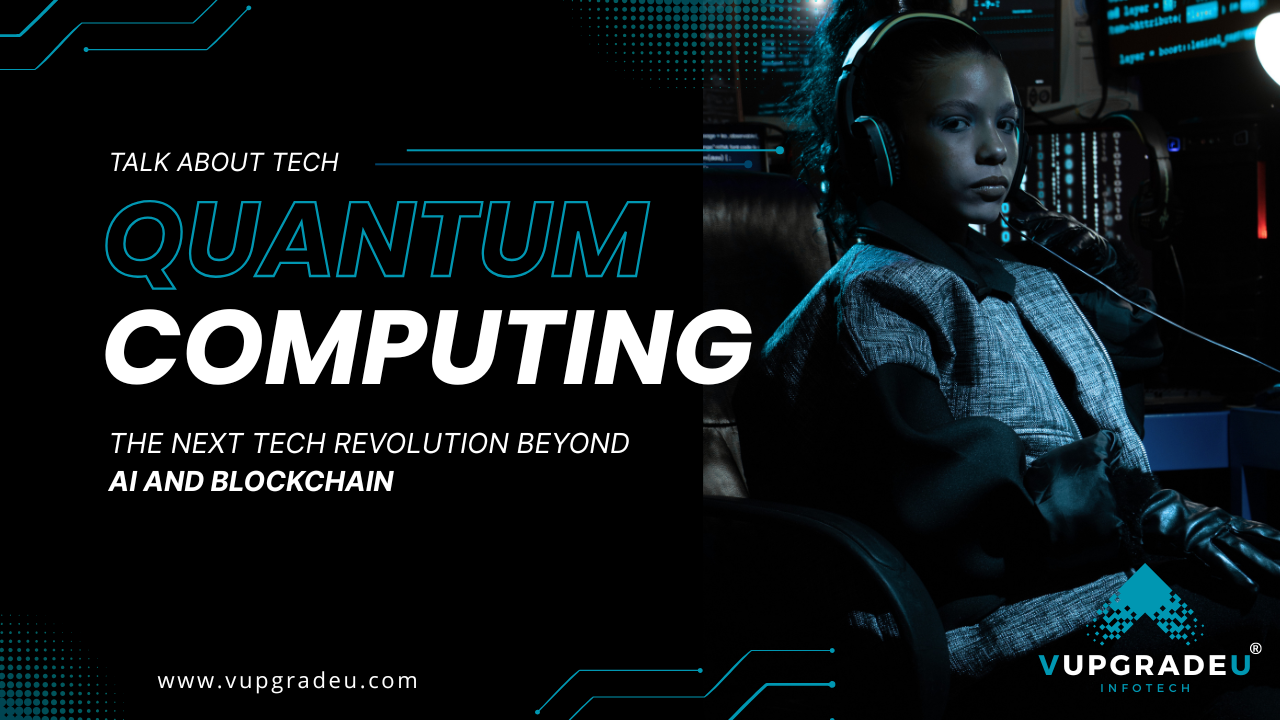
For the past decade, Artificial Intelligence (AI) has dominated the technology landscape. From chatbots to self-driving cars, AI has reshaped how we work and live. But quietly, another revolutionary technology has been evolving in the background—Quantum Computing.
Unlike AI, which focuses on learning patterns and making decisions, quantum computing fundamentally changes how computation itself works. It is not just an upgrade—it is a completely new paradigm.
This blog explores:
- What quantum computing is
- When and how it emerged
- Why it may surpass AI in certain domains
- Its real-world impact on daily life and work
- Why it is now becoming a global trend
What is Quantum Computing?
Quantum computing is an advanced computing technology based on the principles of quantum mechanics, a field of physics that studies matter at extremely small scales.
Unlike classical computers that use bits (0 or 1), quantum computers use qubits, which can exist in multiple states simultaneously (superposition). This allows them to process massive amounts of data in parallel.
Key Concepts:
- Superposition: Multiple states at once
- Entanglement: Instant connection between particles
- Quantum Interference: Enhancing correct solutions
These properties allow quantum computers to solve problems that classical computers would take thousands or even millions of years to compute.
When Was Quantum Computing Discovered?
Quantum computing is not a recent idea—it dates back to the early 1980s:
- 1981: Physicist Richard Feynman proposed quantum simulation
- 1990s: Development of quantum algorithms like Shor’s Algorithm
- 2010s–Present: Rapid advancements by companies like IBM, Google, and startups
Today, we are in what experts call the NISQ (Noisy Intermediate-Scale Quantum) era, where early quantum machines exist but are still developing.
Why Quantum Computing is Trending Now


7
Quantum computing is suddenly gaining massive attention due to:
1. Breakthrough Speed
Quantum computers can perform certain calculations exponentially faster than classical systems.
2. Massive Investment
Tech giants like IBM, Google, and Microsoft are investing billions in quantum research.
3. Real-World Breakthroughs
Recent experiments show quantum systems solving problems thousands of times faster than traditional supercomputers.
4. Industry Potential
Quantum computing could become a $1.3 trillion industry by 2035.
How Quantum Computing is Different from AI
AI and Quantum Computing are often confused, but they serve completely different purposes:
| Feature | AI | Quantum Computing |
|---|---|---|
| Purpose | Learn & predict | Solve complex computations |
| Basis | Data & algorithms | Physics (quantum mechanics) |
| Speed | Fast | Exponentially faster for certain tasks |
| Capability | Pattern recognition | Problem-solving beyond classical limits |
AI is about intelligence, while quantum computing is about raw computational power.
Why Quantum Computing Can Be Better Than AI
Let’s be clear: Quantum computing does NOT replace AI—but in many areas, it can outperform it.
1. Exponential Speed Advantage
Quantum computers can evaluate multiple possibilities simultaneously, making them far faster for complex problems.
2. Better Optimization
AI struggles with optimization problems (like logistics or finance). Quantum algorithms can solve these much more efficiently.
3. Handling Massive Data
Quantum systems can process enormous datasets at once, improving decision-making speed.
4. Improved Simulations
Quantum computing can simulate molecules and materials—something AI alone cannot do accurately.
5. Energy Efficiency
Quantum systems may require fewer computational steps, making them more energy-efficient for certain tasks.
Quantum Computing vs Blockchain
While blockchain focuses on secure decentralized systems, quantum computing focuses on processing power.
In fact:
- Quantum computing can break traditional encryption used in blockchain
- It can also lead to quantum-safe cryptography
This means quantum computing is not just another technology—it could reshape entire digital systems.
Real-Life Applications of Quantum Computing


5
1. Healthcare & Drug Discovery
Quantum computers can simulate molecules, speeding up drug development.
2. Finance
Better risk analysis, fraud detection, and portfolio optimization.
3. Logistics
Optimizing supply chains, delivery routes, and transportation.
4. Climate Modeling
Accurate simulations of climate systems for better predictions.
5. Cybersecurity
Development of new encryption methods.
Impact on Daily Life
Quantum computing may sound futuristic, but it will impact everyday life in surprising ways:
Smarter Healthcare
- Faster diagnosis
- Personalized medicines
Better Transportation
- Reduced traffic
- Faster delivery systems
Improved Internet Security
- Safer online transactions
Faster Innovation
- New materials (stronger, lighter, cheaper)
Impact on Work & Jobs
Quantum computing will reshape how we work:
1. New Job Roles
- Quantum engineers
- Quantum software developers
- Quantum cybersecurity experts
2. Automation of Complex Tasks
Tasks requiring heavy computation (finance, research) will become faster.
3. Hybrid Work Models
Companies will use AI + Quantum systems for decision-making.
4. Increased Productivity
Problems that took weeks will be solved in minutes.
Challenges of Quantum Computing
Despite its promise, quantum computing still faces major hurdles:
1. Fragility of Qubits
Qubits are extremely sensitive to environmental disturbances.
2. High Cost
Quantum machines require specialized environments (near absolute zero).
3. Error Correction
Maintaining accuracy is still a big challenge.
4. Limited Availability
Still mostly in research and early commercial stages.
Future of Quantum Computing
Experts believe:
- Practical quantum computers may emerge in 5–10 years
- Hybrid systems combining AI + Quantum will dominate
- Quantum processors (QPUs) will become as common as CPUs and GPUs
Recent developments already show:
- Quantum chips outperforming classical GPUs in certain tasks
- New architectures enabling 10,000+ qubits
Will Quantum Computing Replace AI?
No—but it will enhance AI massively.
Quantum computing can:
- Train AI models faster
- Improve accuracy
- Solve problems AI cannot
In simple terms:
AI is the brain, Quantum Computing is the superpower.
Conclusion: The Next Big Leap
Quantum computing is not just another emerging technology—it is a fundamental shift in how we compute, solve problems, and innovate.
While AI focuses on intelligence and automation, quantum computing unlocks unimaginable computational power.
In the coming decade:
- Businesses will rely on quantum for complex decision-making
- Healthcare will accelerate breakthroughs
- Cybersecurity will be redefined
- Work productivity will reach new heights
The world is moving beyond AI—and quantum computing is leading the next revolution.
Final Thought
If AI changed how machines think,
Quantum computing will change what machines are capable of.
If you want, I can also: