
Introduction
Imagine having a virtual copy of a machine, factory, hospital, or even an entire city that mirrors its real-world counterpart in real time. This is no longer science fiction—it’s Digital Twin Technology, one of the most transformative innovations driving Industry 4.0.
Powered by Artificial Intelligence (AI), the Internet of Things (IoT), cloud computing, and real-time analytics, digital twins enable businesses to monitor, simulate, predict, and optimize operations like never before.
From manufacturing plants to healthcare systems, digital twins are reshaping how organizations design products, improve efficiency, and make data-driven decisions.
What Is a Digital Twin?
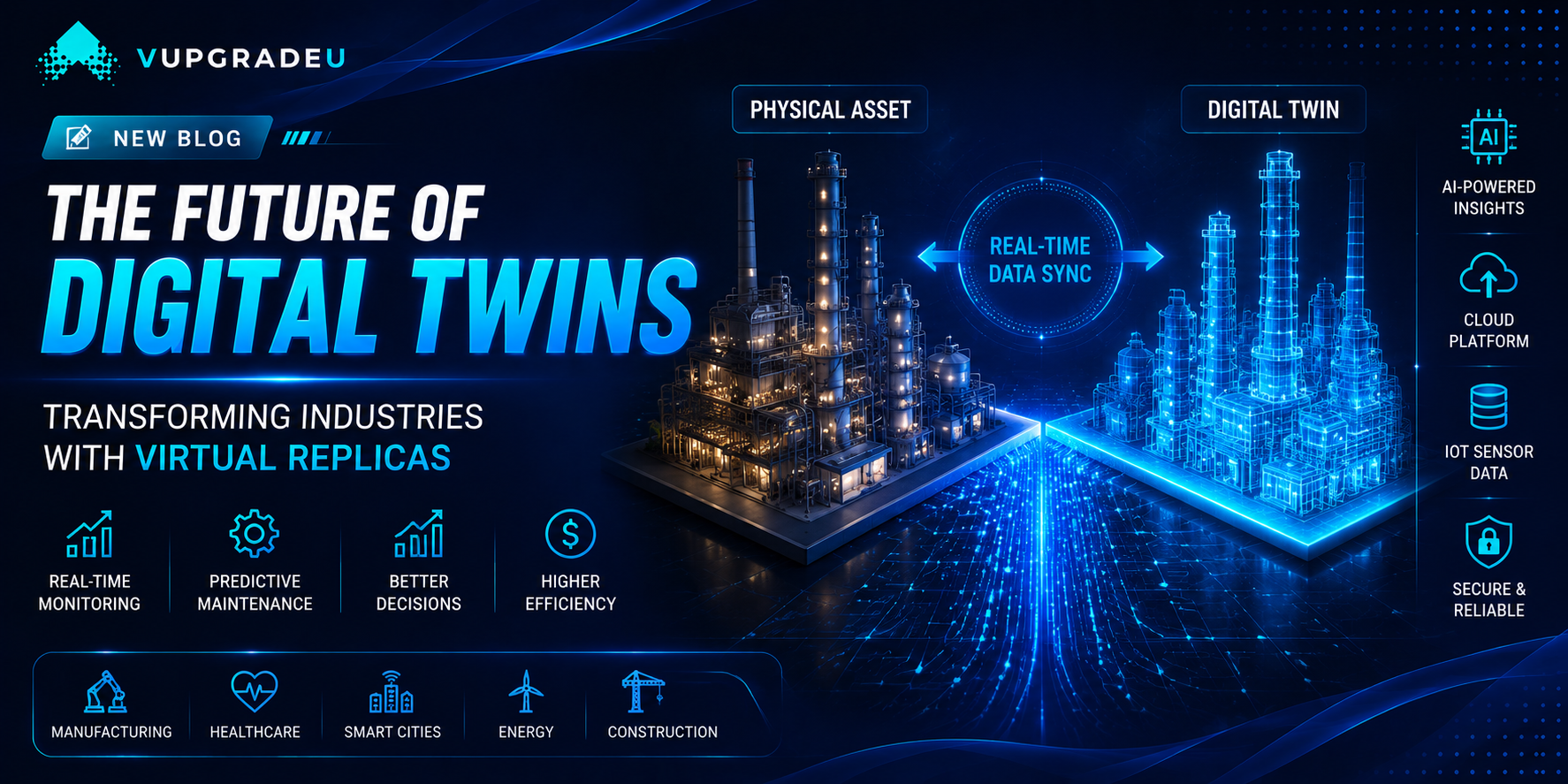
A Digital Twin is a virtual model of a physical object, system, or process. It continuously receives data from sensors and connected devices, allowing it to accurately reflect the real-world asset.
Unlike traditional simulations, digital twins evolve in real time, providing businesses with actionable insights that improve operational performance and reduce risks.
Think of it as a living digital replica that helps organizations understand exactly what’s happening in the physical world.
How Digital Twin Technology Works
Digital Twin technology combines several advanced technologies:
- IoT sensors collect live operational data.
- Cloud platforms store and process massive datasets.
- Artificial Intelligence analyzes patterns.
- Machine Learning predicts future outcomes.
- Data visualization tools present insights through interactive dashboards.
The result is a continuously updated virtual environment that mirrors real-world performance.
Key Benefits of Digital Twins
Predictive Maintenance
Instead of waiting for equipment to fail, businesses can identify potential problems before they happen.
Benefits include:
- Reduced downtime
- Lower maintenance costs
- Longer equipment lifespan
- Improved operational efficiency
Better Product Development
Engineers can test new designs virtually before manufacturing begins.
This helps companies:
- Reduce development costs
- Improve product quality
- Speed up innovation
- Detect design flaws early
Real-Time Monitoring
Digital twins provide live operational visibility across assets and facilities.
Organizations can:
- Monitor performance
- Track energy consumption
- Improve productivity
- Identify operational bottlenecks
Smarter Decision Making
Business leaders gain access to accurate, real-time data that supports faster and more informed strategic decisions.
Industries Using Digital Twin Technology
Manufacturing
Factories use digital twins to monitor production lines, optimize workflows, reduce machine failures, and improve product quality.
Manufacturers can simulate production changes before implementing them, minimizing costly mistakes.
Healthcare
Hospitals are increasingly adopting digital twins to improve patient care.
Applications include:
- Personalized treatment planning
- Medical equipment monitoring
- Hospital resource optimization
- Surgical simulations
The future may even include digital twins of individual patients for precision medicine.
Smart Cities
Governments are using digital twins to create intelligent urban environments.
Examples include:
- Traffic management
- Infrastructure monitoring
- Water management
- Energy optimization
- Disaster preparedness
These virtual city models improve planning and public services.
Energy Sector
Power companies use digital twins to monitor:
- Wind turbines
- Solar farms
- Power grids
- Nuclear facilities
Real-time monitoring helps maximize efficiency while reducing operational risks.
Construction
Construction companies use digital twins throughout the project lifecycle.
Benefits include:
- Improved building design
- Progress tracking
- Safety monitoring
- Lifecycle management
- Cost optimization
The Role of AI in Digital Twins
Artificial Intelligence transforms digital twins from monitoring tools into intelligent decision-making systems.
AI enables digital twins to:
- Predict failures
- Recommend maintenance schedules
- Optimize resource allocation
- Detect anomalies
- Automate business processes
As AI continues to evolve, digital twins will become increasingly autonomous.
Challenges Businesses Should Consider
Despite its advantages, Digital Twin implementation requires careful planning.
Common challenges include:
- High initial investment
- Data integration complexity
- Cybersecurity concerns
- Skilled workforce requirements
- Managing large volumes of real-time data
Businesses should adopt scalable cloud infrastructure and robust security measures to maximize success.
Future Trends
The future of Digital Twin technology is incredibly promising.
Emerging trends include:
- AI-powered autonomous digital twins
- Integration with Generative AI
- Smart factories driven by predictive intelligence
- Digital twins for climate modeling
- Personalized healthcare twins
- Metaverse integration for industrial collaboration
Experts predict digital twins will become a core component of digital transformation strategies across nearly every industry.
Why Businesses Should Invest Today
Organizations that adopt Digital Twin technology early gain significant competitive advantages.
Benefits include:
- Faster innovation
- Improved operational efficiency
- Reduced costs
- Better customer experiences
- Sustainable business growth
- Stronger competitive positioning
As industries become increasingly connected, digital twins will shift from being an optional innovation to a business necessity.
Conclusion
Digital Twin technology is redefining how businesses understand and optimize the physical world. By combining real-time data, Artificial Intelligence, IoT, and predictive analytics, organizations can improve efficiency, reduce costs, and accelerate innovation.
Whether in manufacturing, healthcare, construction, energy, or smart cities, digital twins are paving the way for a smarter, more connected future.
Businesses that embrace this technology today will be better equipped to thrive in tomorrow’s digital economy.
Frequently Asked Questions
What is Digital Twin Technology?
Digital Twin Technology creates a virtual representation of a physical object, process, or system that updates continuously using real-time data.
Which industries use Digital Twins?
Manufacturing, healthcare, energy, construction, aerospace, automotive, logistics, and smart city development are among the leading adopters.
How does AI improve Digital Twins?
AI analyzes real-time data, predicts failures, automates decision-making, and provides actionable insights that improve efficiency and performance.
Are Digital Twins expensive to implement?
The initial investment can be significant, but businesses often achieve substantial long-term savings through reduced downtime, optimized operations, and predictive maintenance.
What is the future of Digital Twin Technology?
The future includes AI-driven automation, autonomous digital twins, smart cities, personalized healthcare, industrial metaverse applications, and deeper integration with IoT ecosystems.