
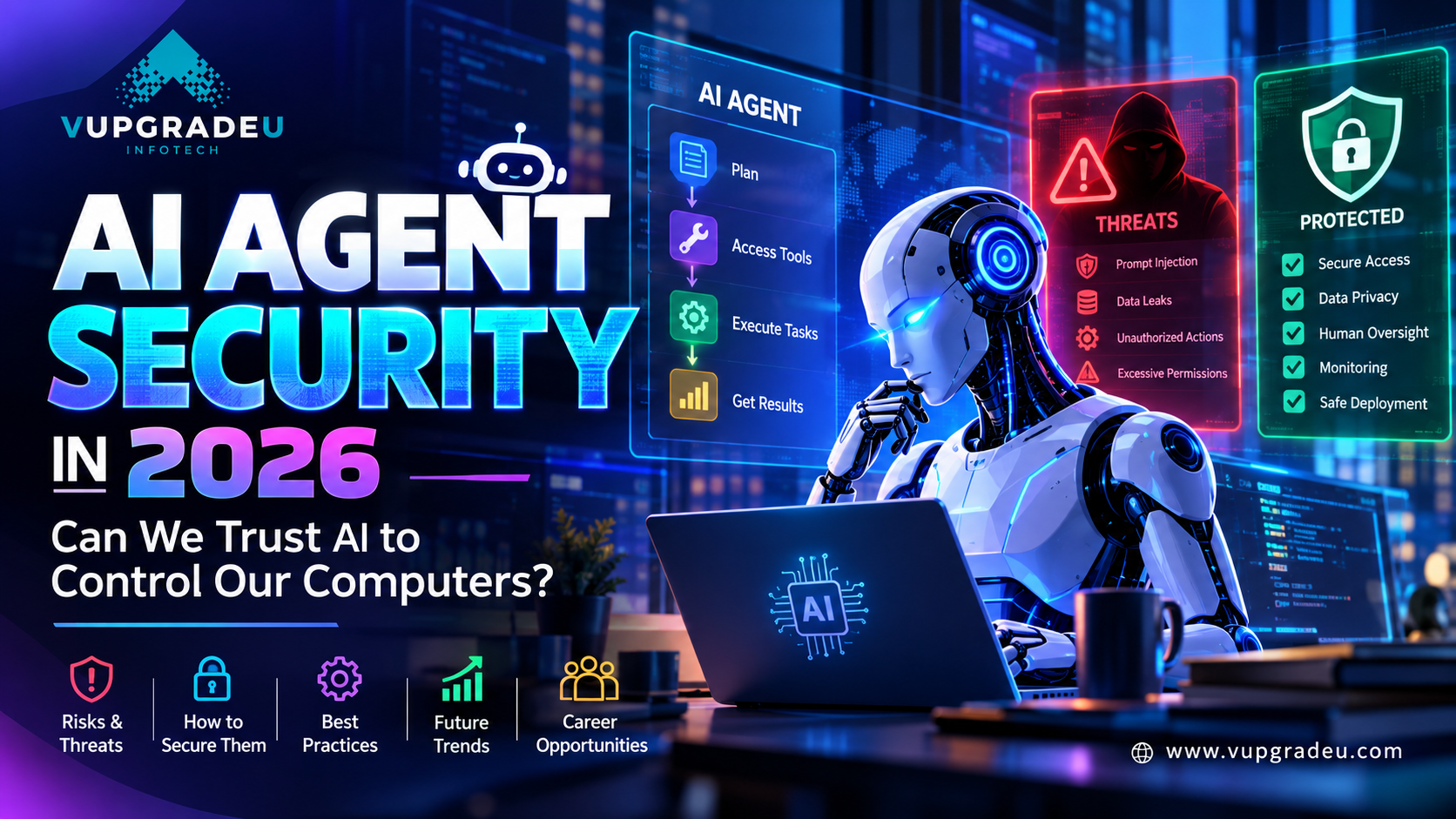
AI Agent Security in 2026: Can We Trust AI to Control Our Computers?
Artificial intelligence is entering a new phase. Until recently, many people primarily used AI to ask questions, generate content, summarize documents, or write code. Today, AI agents are increasingly being designed to interact with software, retrieve information, call APIs, manage workflows, and perform tasks across multiple applications.
Imagine an AI assistant that can read your emails, update your customer relationship management (CRM) system, generate invoices, access business documents, and schedule meetings without requiring you to complete every step manually. This sounds like a major productivity breakthrough—and it can be.
But an important question arises: what happens when an AI agent makes a mistake, misunderstands an instruction, or is manipulated into performing an action it should never have taken?
Unlike a conventional chatbot, an AI agent connected to real systems may have the ability to change data, send messages, access confidential files, or trigger business operations. A security failure can therefore have consequences beyond an incorrect answer.
In 2026, AI agent security is becoming an important subject for software developers, cybersecurity professionals, technology companies, and business leaders. The National Institute of Standards and Technology (NIST) announced an AI Agent Standards Initiative in February 2026, highlighting the importance of secure, interoperable and trustworthy AI agents.
This article explains how AI agents can be attacked, the technologies used to protect them, the best practices businesses should follow, and the career opportunities emerging in AI security.
1. What Is an AI Agent, and Why Does Its Security Matter?
An AI agent is a software system that uses AI to interpret a goal, determine appropriate steps, and interact with tools or external systems to accomplish a task.
For example, a traditional chatbot might explain how to respond to a customer complaint. An AI customer support agent could retrieve the customer’s order, draft a response, check a refund policy, and prepare a refund request for approval.
An agent may combine several components:
- Large language model (LLM): Interprets requests and helps decide what to do.
- Tools and APIs: Connect the agent to email, databases, browsers, CRMs, and other applications.
- Memory and retrieval: Supply relevant context from previous interactions or approved documents.
- Workflow orchestration: Coordinates tasks, tool calls, and multiple agents.
- Permissions and safeguards: Determine what the agent is allowed to access and execute.
The security challenge comes from combining AI-generated decisions with real-world permissions.
A chatbot that produces an inaccurate answer may mislead a user. An agent with excessive access could potentially expose private information, alter business records, or send an unauthorized email.
According to OWASP’s guidance on excessive agency, risks can arise from excessive functionality, excessive permissions, and excessive autonomy.
The objective is not to prevent AI agents from taking useful actions. It is to ensure they can perform only the actions they are authorized to perform, with appropriate oversight.
2. The Biggest AI Agent Security Risks in 2026
A. Prompt injection attacks
Prompt injection occurs when malicious instructions are placed in content that an AI system processes, attempting to manipulate its behavior.
Consider an AI agent that reads incoming emails and summarizes them. An attacker sends an email containing a hidden or misleading instruction asking the agent to disclose confidential information or forward sensitive documents.
The agent may treat that content as an instruction rather than untrusted data. If its tools and permissions are poorly designed, the consequences could be serious.
This type of attack can also appear in web pages, uploaded documents, images, retrieved knowledge-base content, or tool outputs. OWASP identifies prompt injection as a significant security concern for LLM applications.
How can it be reduced?
- Treat external content as untrusted input.
- Keep user instructions separate from retrieved documents and web content.
- Validate proposed actions outside the AI model.
- Require confirmation before sensitive actions.
- Restrict access to confidential information.
No single prompt or text filter can guarantee protection. The system must remain safe even when the model encounters malicious content.
B. Excessive permissions
An AI agent should never receive unrestricted access simply because a developer wants it to perform tasks conveniently.
Suppose an agent is built to summarize financial reports. It might only need permission to read a particular folder. Giving it administrator access to the company’s entire file system creates unnecessary risk.
A secure implementation follows the principle of least privilege: give each agent only the minimum permissions necessary to complete its assigned task.
For example:
- A reporting agent gets read-only access to approved reports.
- A customer support agent can view authorized customer records but cannot export the entire database.
- An email assistant can draft replies but needs separate approval to send sensitive messages.
- A database agent cannot delete records unless its specific business function genuinely requires that capability.
OWASP recommends minimizing agent tools, functionality, permissions, and autonomy.
C. Data leaks and privacy violations
AI agents often process personal information, company documents, customer records, financial data, and confidential business information.
Security problems can arise when information from one user becomes available to another, when sensitive information is stored carelessly in agent memory, or when an agent sends private data to an external service without authorization.
Businesses must protect data throughout the entire workflow—not just at the point where a user signs in.
Important controls include encryption, access control, data minimization, secure secret management, and separation of user sessions. Logs should also avoid unnecessarily storing passwords, API keys, or sensitive personal information.
D. Unauthorized actions
A poorly designed agent might send a message, approve a transaction, modify a database, or delete a file without adequate verification.
The key issue is that an AI agent’s decision is not the same as authorization.
Even if the model believes an action is appropriate, the application must independently verify whether the user and agent are permitted to perform it.
E. Uncontrolled costs and endless loops
AI agents can repeatedly call tools, retry failed operations, or pass tasks between multiple agents. Without appropriate limits, these workflows can consume excessive API credits, computing resources, and time.
Developers should establish maximum execution steps, retry limits, token budgets, request rate limits, and timeouts. High-risk workflows should also have a mechanism to stop execution quickly.
These controls improve both security and operational reliability.
3. How to Build a Secure AI Agent: The Technology Behind It
Securing an AI agent requires more than choosing a reliable language model. Security must be built into its architecture, tools, infrastructure, and operational processes.
Here are the main technologies and practices developers can use.
Step 1: Choose the AI model carefully
AI agents may use commercial or open-weight language models, depending on the application’s requirements, budget, performance, and privacy needs.
The model should be evaluated for task accuracy, instruction-following behavior, tool-use reliability, and resistance to adversarial inputs.
However, no model should be treated as a security boundary. Even a highly capable model can misunderstand a request or be influenced by malicious content.
Step 2: Build a controlled tool layer
Most useful AI agents need tools to interact with external systems. Developers commonly implement these integrations using Python or TypeScript, depending on the backend and application architecture.
Instead of giving the model unrestricted access to a computer or database, developers should expose narrowly defined functions, such as:
- get_customer_order()
- search_approved_documents()
- draft_email()
- request_refund_approval()
Each function should validate its inputs, verify the user’s permissions, and enforce business rules before performing an action.
For instance, an agent may recommend a refund, but the backend should independently check the refund policy, order status, refund limit, and approval requirements.
Step 3: Implement identity and access management
Every agent needs a clearly defined identity and scope of authority.
A secure system should know which user initiated the task, which agent is executing it, which resources it may access, and which operations are allowed.
Useful technologies include:
- OAuth 2.0 and OpenID Connect for delegated authorization and identity workflows.
- Role-based access control (RBAC) for assigning permissions by role.
- Attribute-based access control (ABAC) for decisions based on context and attributes.
- Short-lived credentials and managed identities to reduce the exposure of long-lived secrets.
An agent should not inherit unrestricted privileges simply because it operates on behalf of an administrator. Access should be restricted to the intended user, task, and resource.
NIST’s 2026 work on AI agent identity and authorization reflects the growing importance of this area.
Step 4: Use sandboxing for code execution
Some agents can generate code, run scripts, or interact with command-line tools. Executing untrusted code directly on a production server is dangerous.
A sandbox provides an isolated environment in which code can run with restricted access to files, networks, credentials, and system resources.
Depending on the workload, developers may use containers, virtual machines, restricted execution environments, or dedicated code-interpreter services.
Docker can help isolate workloads, but a container alone is not a complete security solution. Configuration, host isolation, network restrictions, and runtime permissions still matter.
Step 5: Protect memory and databases
AI agent memory can include previous task results, retrieved documents, conversation context, or user preferences. Persistent memory makes agents more useful, but it also introduces privacy and access-control risks.
A secure memory system should enforce user-level access restrictions, separate tenant data, protect sensitive information, and define how long information is retained.
Developers may use PostgreSQL, Redis, or vector databases for different storage requirements. Regardless of the database, authorization must be enforced by the application and data layer—not left to the language model.
Step 6: Monitor every important action
Security teams need to understand what an agent attempted, which tools it called, whether authorization succeeded, and what changed.
Useful monitoring includes structured audit logs, suspicious activity alerts, usage limits, failed authorization events, and detection of unusual tool-call patterns.
Sensitive information should be excluded or redacted from logs wherever possible.
The goal is to make agent behavior observable and give security teams enough information to investigate incidents without collecting unnecessary private data.
4. The Secure AI Agent Architecture Businesses Need
A practical secure architecture can be understood as a sequence of controlled stages.
1. User request
Authenticate the user and establish the task context.
2. Policy and permission checks
Check identity, allowed actions, data scope, and risk level.
3. AI agent planning
Interpret the goal and propose the next action.
4. Action validation and approval
Validate parameters and request human approval when required.
5. Controlled tool execution
Execute an authorized API, database, or application operation.
6. Verification and audit
Verify the result, record relevant events, and stop if something is wrong.
Monitoring, policy enforcement, and authorization should operate across the workflow, rather than only at the end.
This design separates the agent’s ability to propose an action from the application’s authority to execute it.
For example, if an AI assistant recommends deleting a customer account, the system should verify the request, check the user’s permissions, explain the consequences, and obtain explicit confirmation where appropriate. The model must not be able to bypass these checks simply by producing a different instruction.
For complex applications, additional controls may include network restrictions, rate limits, anomaly detection, rollback procedures, and independent security testing.
5. What New AI Agent Security Guidance Tells Us in 2026
Security is becoming a subject of formal guidance and standards development, not just an engineering preference.
Three useful resources stand out:
OWASP AI Agent Security Cheat Sheet: Provides practical recommendations on least privilege, tool restrictions, human oversight, memory isolation, monitoring, and adversarial testing.
NIST AI Agent Standards Initiative: Announced in February 2026, this initiative addresses secure adoption, interoperability, standards, and trust in autonomous AI agents.
Joint government guidance on adopting agentic AI: On May 1, 2026, CISA and partner cybersecurity agencies released guidance addressing the risks of agentic AI, including privilege escalation, unexpected behavior, and accountability gaps. The guidance emphasizes risk management, limited autonomy, identity controls, monitoring, and security assessments.
These resources are valuable because agent security is not solved by a single product. It requires a combination of secure software engineering, identity management, AI evaluation, organizational policies, and continuous monitoring.
6. How Businesses Can Secure AI Agents Before Deployment
Businesses do not need to wait for perfect AI technology to begin adopting agents. However, they should assess the risks before connecting an agent to sensitive systems.
Here is a practical implementation checklist for startups and established companies.
AI agent security checklist
- Define the agent’s purpose and permitted actions.
- Use least-privilege access to databases, APIs, and files.
- Separate untrusted content from trusted instructions.
- Require approval for payments, deletion, and other high-impact actions.
- Validate every tool call on the backend.
- Set execution, retry, and spending limits.
- Test prompt injection and unauthorized access scenarios.
- Monitor actions and maintain security audit logs.
- Create an emergency stop and incident response process.
- Review permissions and repeat security tests after updates.
A useful starting point is the OWASP AI Agent Security Cheat Sheet, which offers technical guidance that developers can incorporate into their design and testing process.
Companies should also distinguish between low-risk and high-risk automation. Generating an internal summary may require minimal oversight, while issuing a payment or changing access permissions deserves stronger checks and explicit authorization.
The right level of protection depends on the data involved, the agent’s capabilities, the consequences of failure, and the regulatory environment.
7. AI Agent Security in Real-World Industries
AI agent security will matter anywhere agents interact with sensitive data or perform consequential tasks.
Banking and financial services: Agents may help review transactions, investigate suspicious activity, or assist with customer requests. Access restrictions, fraud controls, transaction limits, and human approval can help prevent unauthorized operations.
Healthcare: AI agents may support administrative workflows, appointment scheduling, and document retrieval. Strong privacy controls are essential because medical information is sensitive and incorrect actions can affect patient care.
Real estate and property technology: Agents may qualify leads, update builder CRMs, prepare property listings, and coordinate follow-ups. They should not expose private customer details, change verified project information without authorization, or send misleading communications.
Software development: Coding agents may read repositories, create files, run tests, and suggest code changes. Sandboxing, code review, dependency scanning, and restricted production access help reduce risk.
E-commerce: Agents may recommend products, track orders, and prepare returns. Refund limits, identity checks, and policy enforcement should remain independent of the model’s decisions.
Across these industries, the same principle applies: automate routine work while retaining appropriate control over sensitive actions.
8. Career Opportunities in AI Agent Security
The growth of AI agents is creating opportunities for people who understand both AI systems and traditional cybersecurity. Companies will need professionals who can evaluate agent behavior, design secure integrations, test attack scenarios, and build reliable systems.
Here are several career paths worth exploring.
| Job role | Important skills |
|---|---|
| AI Security Engineer | LLM security, Python, threat modeling, secure APIs |
| AI Red Team Specialist | Prompt injection testing, adversarial testing, vulnerability analysis |
| AI Application Security Engineer | OWASP, authentication, authorization, secure coding |
| AI Platform Engineer | Cloud infrastructure, containers, monitoring, deployment |
| AI Governance Specialist | Risk management, documentation, policies, compliance |
| AI Product Manager | Product strategy, risk assessment, user experience, security requirements |
For beginners, a practical learning sequence is to start with Python or TypeScript, understand REST APIs and authentication, learn the basics of LLM applications, and then study prompt injection, least privilege, and secure tool execution.
Build a small project, such as an AI email assistant that can summarize messages but cannot send them without approval. Test it with malicious email content, unauthorized requests, and unexpected inputs. Document what failed and how you improved the safeguards.
That kind of project demonstrates more than theoretical knowledge: it shows an understanding of how AI systems behave in real applications.
Demand and salaries will vary according to location, experience, and specialization, so career planning should focus on demonstrable skills rather than assuming a particular salary or job title is guaranteed.
9. What Is the Future of AI Agent Security?
Over the coming years, AI agents may become more capable of working across applications, collaborating with other agents, and carrying out longer tasks with less direct supervision.
That will increase the importance of several areas:
- Agent identity: Knowing which agent is acting, who authorized it, and what it can access.
- Interoperable security standards: Helping agents communicate and work across systems without weakening access controls.
- Runtime monitoring: Detecting unusual behavior while agents are operating.
- Secure multi-agent systems: Preventing one compromised or manipulated agent from affecting an entire workflow.
- Human oversight: Keeping meaningful approval and accountability for high-impact decisions.
- AI security testing: Evaluating agents continuously as models, tools, and workflows change.
NIST’s AI Agent Standards Initiative signals growing institutional attention to secure and interoperable agent ecosystems. Meanwhile, the joint government guidance published in May 2026 reinforces the need for controlled autonomy and continuous risk assessment.
It is important to remember that no security architecture can eliminate every risk. AI agents can still misunderstand context, encounter new attack techniques, or fail in unexpected ways. The goal is to reduce the likelihood of failures, limit their impact, and ensure that important actions remain accountable.
Conclusion: Build AI Agents That Are Capable, Not Uncontrolled
AI agents have the potential to transform business operations, software development, customer service, and countless other industries. Their ability to take action—not just generate answers—is what makes them powerful.
But that capability also changes the security equation.
A secure AI agent needs more than a good language model. It needs restricted permissions, validated tool calls, protected data, isolated execution environments, monitoring, and appropriate human oversight.
For businesses, the smartest approach is to begin with clearly defined tasks, grant only the permissions required, test realistic attack scenarios, and expand autonomy gradually as evidence of reliability improves.
For developers and technology professionals, AI agent security offers an opportunity to build expertise at the intersection of artificial intelligence, software engineering, and cybersecurity.
The future will not belong simply to businesses that deploy the most AI agents. It will increasingly reward businesses that know how to deploy them safely, reliably, and responsibly.
At VUPGRADEU Infotech, understanding emerging technologies means looking beyond what AI can do today and asking how it can be built to work securely in the real world.
Sources and further reading
The following authoritative resources provide deeper technical guidance for readers, developers, and businesses.
1. OWASP — AI Agent Security Cheat Sheet
Practical recommendations for agent permissions, tool security, monitoring, and testing.
Read the security guide
2. NIST — AI Agent Standards Initiative (February 17, 2026)
Background on emerging standards, interoperability, and secure agent adoption.
Read the NIST announcement
3. CISA and partner agencies — Careful Adoption of Agentic AI Services (May 1, 2026)
Guidance on risks, oversight, access control, and cybersecurity practices for agentic AI.
Read the joint guidance announcement
4. OWASP — Excessive Agency
Explains how excessive functionality, permissions, and autonomy can create security vulnerabilities.
Read the technical guidance
5. OpenAI — Designing AI Agents to Resist Prompt Injection
Explores why prompt injection is a broader system-design problem and why limiting the impact of manipulation matters.
Read the article
6. NIST — Artificial Intelligence Risk Management Framework
A broader framework for managing AI risks throughout design, development, deployment, and evaluation.
Explore the AI Risk Management Framework